About Kinstak
Technology got very good at keeping files. It never learned to keep people.
Your life is scattered across clouds, apps, phones, and drives in a drawer. The photos are somewhere. The recipes, the voice memos, the work you're proud of, the records your family will need someday — all of it exists, and almost none of it can be found when it matters. And when a person is gone, their family too often inherits a locked device instead of a life.
Kinstak was built to fix that.
Today, Kinstak gives you one search across the sources you choose to connect, with separate Personal and Business libraries. Read-only indexing leaves your originals where they are — nothing is moved or deleted. When you choose to import or back up selected files, that is a deliberate copy you start.
What we believe is simple: identity is infrastructure. The record of a life or a business isn't clutter. It's the knowledge, context, and story that help us understand where we came from and decide what comes next.
We are the memory keepers. And we're just getting started.
Our mission
People and businesses should own their data — for their families and for generations — not rent it from platforms that can take it away.
We exist to help people and small businesses bring together what matters, make it easier to find and use, and keep control of it. So no one has to throw away a hard drive and wonder what was lost.
Our vision
A world where every person and business owns a unified, portable memory layer that the tools and AI they choose can use — so knowledge, context, and story aren't lost to a platform, a price change, or the passage of time.
We are building human data infrastructure for the AI era: a way for information to stay useful in everyday life and remain available to the next generation. Universal AI access, permanent ownership, and generations-long storage describe where we're headed, not guarantees available today.
Who we serve first
Small contractors and service businesses whose data is scattered across tools they don't control — and who lose evenings and weekends finding what they already have.
We start here because the problem is immediate: AI can't help with information it can't find or access. Our mission reaches people, families, and businesses; this is where we focus first.
The Founder's Story
I grew up with gaps where a story should have been.
I'm an adoptee. My adoptive parents were good, hardworking people — but I grew up without baby pictures, without a birth story, without a face at the table that looked like mine. I spent my childhood searching other people's faces for my own. Most people never notice the thread of knowing where they come from, because they've always had it — the shoebox of photos, the recipe card in a grandmother's handwriting, the story told the same way every Thanksgiving. I noticed. I was living without it.
Then I lost my mother before I ever really had her.
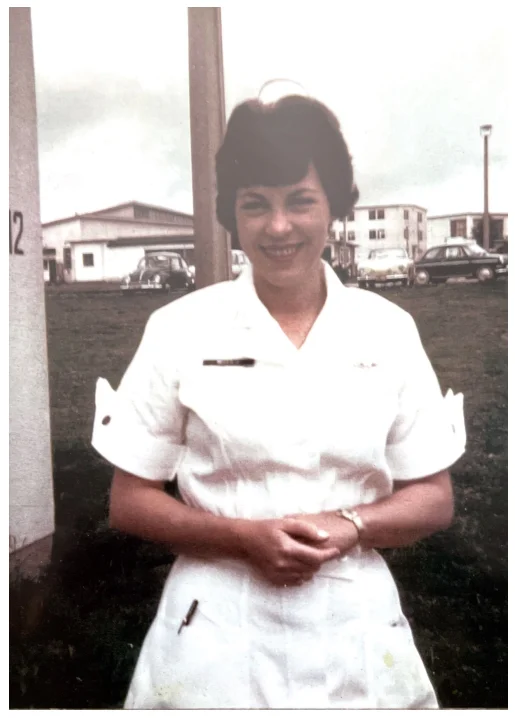
My adopted mother, Major Joan M. Wells, USAF (ret.), was a trailblazer for women in the military at a time when the military wasn't asking for one. Everything I know about leading — discipline, service, showing up when it's hard — I learned by watching her. She died unexpectedly in 1999. I was 24.
Here's the thing about losing someone at 24: you don't yet know which questions you should have asked. Her voice. Her opinions. The way she processed a hard day. What she knew about her own health that might matter for mine. The stories she carried that no one thought to write down, because everyone assumed there would be more time. There wasn't more time. There never is.
What she left behind wasn't a story. It was a silence with edges.
Then I became a mother, and everything sharpened.
I have a son and a daughter, and the moment you become a parent, time collapses: you feel the past and the future at once. I looked at my children and asked — what will they know about where they come from? What will survive me that actually matters? Not my files. Not a folder called “family_photos_FINAL_v2.” Me. My voice, my reasoning, my health history, the things I figured out the hard way so they wouldn't have to.
That knowledge used to pass from person to person — through proximity, conversation, time spent together. We lost the infrastructure for that transmission. And nobody was building it back.
So I built it.
I'm not a software engineer, and I didn't come from Silicon Valley. I spent two decades in enterprise technology, building the distribution channels that put complex technology into millions of hands — and years before that in education, helping people build futures while watching every institution quietly fail to help them hold on to what they came from. I stopped waiting for someone else to build what I needed.
Kinstak is the thing I wish had existed for my mother. And her mother. And every person who passed on before anyone thought to ask them the right questions. It's built for my children, for their children — and for everyone who grew up, like me, with gaps where a story should have been.
— Carolyn Eagen, Founder & CEO
Our Values
We are the Memory Keepers.
Preserving what matters is a responsibility, not just a feature. We treat people's data with the care we would want for our own family's.
Ownership is non-negotiable.
Your data is yours. You choose what to connect and can disconnect it. We are building toward private, portable storage that lets you leave without leaving your history behind.
Identity is infrastructure.
The record of a life or a business isn't clutter to be monetized. It's foundational. The people, decisions, and experiences behind a file deserve as much care as the file itself.
Generational knowledge is sacred.
The knowledge we inherit — a family recipe, a craft learned on the job, a lesson no one thought to write down — too often disappears with the person who held it. We are building so more of it can be passed on.
Usable today. Built for generations.
We reject the choice between a tool you use every day and an archive you can pass down. Our goal is both: useful now, with private and portable storage that lasts for generations. That permanence is a goal, not a guarantee available now.
What do you wish you had preserved from someone you've lost?
Whatever your answer is — a voice, a laugh, a recipe, a health history, a story you only half remember — that answer is exactly why Kinstak exists.
Start building your family's archive · Contact us
Questions about Kinstak
What is Kinstak?
Kinstak helps people find family memories, everyday records, and the files behind their independent work. It gives you one search across the sources you choose to connect, in separate Personal and Business libraries, without moving or deleting your originals.
Who founded Kinstak?
Kinstak was founded by Carolyn Eagen, its Founder & CEO. She spent two decades in enterprise technology and, before that, worked in education.
Why was Kinstak started?
Carolyn is an adoptee who lost her adoptive mother, Major Joan M. Wells, USAF (ret.), in 1999, when she was 24. Becoming a mother made her ask what her own children would know about where they come from. Kinstak is her answer: a way to find what matters and keep it for family.
What does Kinstak do today, and what is still vision?
Today: search across connected sources you choose, separate Personal and Business libraries, read-only indexing that leaves originals in place, and deliberate copies only for imports or backups you select. Still being built: private and portable storage that lasts for generations. That is a goal, not a guarantee available now.